
Learning Path : I already invest in fixed income
Good choice. You're ready to go beyond the basics
Estimated time: 8-10 minutes to complete
By the end of this path, you'll have everything you need to take full control of your bond portfolio through direct ownership — and to open a FIIG account and start building one. At any time during the process, you can choose to speak with a FIIG Fixed Income Expert by clicking the "Talk to an Expert" button above, and they'll call you back to discuss investing in bonds.
With over 28 years in the fixed income markets, FIIG can help you get the best out of your bond portfolio.
If you already understand what bonds are and how important they are to a balanced and diversified portfolio, then you are ready to really take control of your bond investments through FIIG’s Direct Bonds model. This is where you can tailor a fixed income portfolio to suit your investment goals. First of all, let’s discuss what direct bond ownership is.
Learning goals
- Why direct bonds give more control than ETFs
- How to tailor your portfolio to your goals, values, and risk appetite
- How FIIG protects your holdings and gives exclusive access to originated bonds
- How to get started with your FIIG account
Meet your expert guides
Throughout this journey, you’ll receive insights from experienced specialists on FIIG’s Investment Strategy and Research team — professionals who help Australians achieve their retirement income goals every day.

Jessica Rusit
Director – Investment Strategy
12+ years of experience in financial markets
Philip Brown
Head of Research
20+ years of experience in researchWhat is Direct bond ownership?
FIIG’s direct bond service enables investors to buy and sell corporate bonds in parcels from as little as $10,000 with a minimum portfolio size of $50,000 and gives investors direct, beneficial and legal ownership of their bond portfolio. Similar to a share portfolio, investors have the ability to hand select the bonds they wish to invest in, and can buy and sell when they choose, giving them complete control.
This flexibility isn’t possible through an indirect bond ownership model like a managed fund or Exchange Traded Fund (ETF). In indirect ownership models the bond selection and decision-making is made on behalf of the investors collectively with no regard to individual preferences.
The ETF trade-off
Direct ownership means every bond in your portfolio is there because you chose it — matched to your goals, your risk appetite, and your view of the market.
In the past, corporate bonds were only available in $500,000 parcels making ownership of bonds unachievable for many private investors and SMSFs. However, FIIG has opened up access to corporate bonds in smaller parcels, giving this client segment direct access to holding a portfolio of bonds.
To really invest in bonds to their full potential, you need to be in control of your bond portfolio, and this can be done through Direct Bond investment.
Most investors don't realise how much customising a portfolio can improve their outcomes. When we build a direct bond portfolio with a client, the first question we ask is: what matters to you? The answer shapes everything that follows.
Jessica Rusit
FIIG – Director – Investment StrategySo what does that control actually look like in practice? Here's a closer look at the real benefits of direct bond ownership.
Benefits of direct bond ownership
You've possibly been investing in bonds through Bond ETFs or managed funds, which provides an allocation to bonds, but not the ability to select the bonds within that allocation. Direct bond ownerships allows control over allocation decisions, with the help of your FIIG Relationship Manager, who is there to guide throughout the whole process.
There are real advantages of direct bond ownership, which include:
- The ability to tailor a portfolio: Investors can customise their own bond portfolio to suit their preferences (i.e. ESG and Green bond allocations), investment goals (i.e. specific income needs), along with your market outlook (i.e. adjusting risk for what's ahead).
- The ability to adjust for risk preferences: Investors can take higher levels of risk in search of higher returns or deliberately skew towards (or away) from business models or businesses that you have personal opinions about.
- Higher returns on offer: Most bond ETFs are linked to a wide market definition of investable bonds, which the Australian bond market is dominated by Government bonds. Government bonds are very safe investments, but you are foregoing potential yield for that safety. Direct bond ownership allows more control to select bonds that offer better returns.
- Diversification: Through the ability to tailor your bond portfolio through direct bond ownership, you also know exactly what your bond allocations are. This provides the ability to better diversify your bond portfolio to complement your existing investments.
Built around you
Every direct bond portfolio starts with your goals, your risk appetite, and your view of the market — not a fixed index or fund mandate.
You now know what direct ownership can do for your portfolio — but how do you know your bonds, and your money, are actually safe?
FIIG Securities - original pioneers in the fixed income market
FIIG is one of the leading and most established pure fixed income advisory houses in Australia, established in 1998 and has been at the forefront of providing fixed income access to investors. FIIG has offices in four capital cities: Sydney, Melbourne, Brisbane and Perth. We provide over 6,000 clients with access to a diverse range of bonds, including government bonds, Residential Mortgage Back Securities (RMBS), high yield, non-AUD denominated bonds and securitised notes. FIIG has grown to over $4.5bn in funds under management and joined with AUSIEX in June 2025.
FIIG has originated over 100 transactions through its Debt Capital Markets (DCM) division, enhancing returns for fixed income investors in the Australian bond market. These in-house originated transactions are exclusively available to FIIG clients and offer unique high yielding exposures to portfolios.
AUSIEX (Australian Investment Exchange) is one of Australia’s leading providers of trading execution, clearing and settlement, and portfolio/administration services for financial institutions, advisers, wealth platforms and intermediaries. AUSIEX has been owned by global Japanese technology and financial services group, Nomura Research Institute (NRI), since 2021. NRI has a market capitalisation of $28.8bn as of July 2026. This merger has further enhanced FIIG’s ability to offer the best level of systems and service to its clients.
I've spoken with many investors who didn't realise how much of a difference selecting their own bonds can make to overall returns. Once they see it, it changes how they think about their whole portfolio.
Philip Brown
FIIG - Head of ResearchFull visibility, real diversification
With direct bonds, you know exactly what you own — so you can deliberately diversify away from your share and property risks.
You now know the scale and credibility behind FIIG — but how exactly are your bonds kept safe once you invest?
Safety and security is how FIIG operates
FIIG uses J.P. Morgan, one of the largest banks in the world, as sub-custodian and safe-holding of all bonds purchased and sold through FIIG. This means that your bonds are your assets at all times and held in your individual custody account. As such they do not form part of the assets of FIIG or the custodial bank. Therefore, if FIIG or the custodial bank were to cease operations, your bonds are safe and remain yours. FIIG is fully licensed to provide custodial services and is regulated by ASIC.
In response to global cyber security threats FIIG is continually upgrading its cyber defences to improve security, while it also annually undertakes an independent assurance report on internal controls relating to its custody Service. This audit (GS007 type 2) is an international standard to which Global Custodians adhere and is performed by Ernst & Young.
Since the acquisition of FIIG by AUSIEX in 2025, FIIG has enhanced capabilities and is backed by NRI, which has a market capitalisation of $28.8bn as of July 2026.
FIIG clients have 24hr online access to their portfolio via the client portal, MyFIIG. This provides clients with the ability to monitor their portfolio in real-time. Monthly portfolio valuations are issued every month and emailed to clients, along with an annual portfolio review in July each year.
The GS007 Type 2 audit is the same standard global custodians are held to — it's not something smaller firms typically undertake. It's one of the reasons I feel confident recommending FIIG to clients who prioritise security.
Philip Brown
FIIG - Head of ResearchYou now know how FIIG keeps your bonds secure — so what's the simplest way to actually get started building your portfolio?
How do you buy bonds?
Bonds can easily be bought, held and even sold once a FIIG account has been established. This can be done online via a few simple clicks, or you can ring to speak with a FIIG Fixed Income expert or arrange a face-to-face meeting at any time in one of our offices in Sydney, Melbourne, Brisbane or Perth.
As part of becoming a FIIG client, a bond investor has a dedicated Relationship Manager to help at any time, along with access to monthly portfolio reporting, and to publications from the Research and Investment Strategy teams. These include the quarterly macro-outlook, which provides insights into the market outlook, along with bond specific credit updates, strategy articles, FIIG’s weekly newsletter for clients called “Smart Income”, as well as seminars and webinars. Client assets are held in segregated safe custody by J.P. Morgan, a leading global custodian, providing an additional layer of security and protection of client assets.
FIIG clients also have the ability to trade online via the client portal, MyFIIG, where there are over 1,000 bonds to choose from. The portal allows FIIG clients to compare returns, coupons, and credit rating, among other key features to make a more-informed selection . Through MyFIIG, clients have the ability to not only place orders, but also monitor their orders in real-time.
Clients consistently tell me how much they value the flexibility of having their own dedicated Relationship Manager — someone who knows them and how they invest.
Jessica Rusit
FIIG – Director – Investment StrategyReady to take control of your bond portfolio?
Open a FIIG account and start investing in direct bonds today.
Open your FIIG accountFIIG is Australia's leading fixed income specialist — trusted by 6,000+ investors since 1998.
Prefer to speak with an expert first? Book a free consultation to learn how fixed income can work for your situation.
Portfolio examples
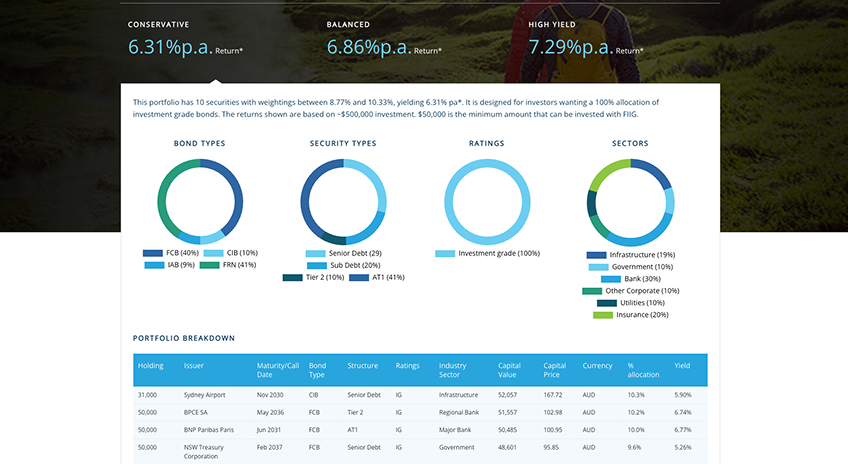
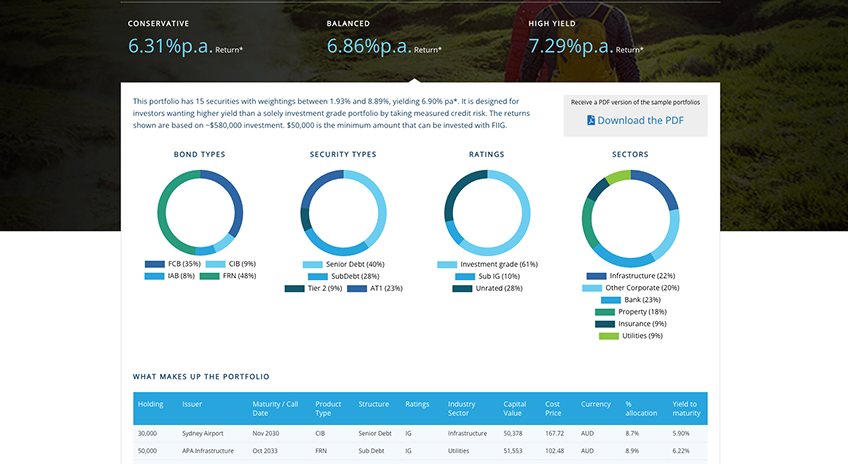
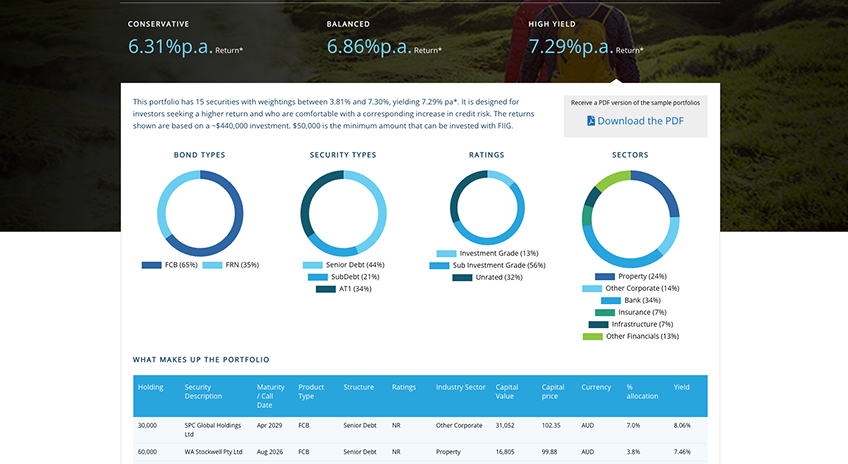
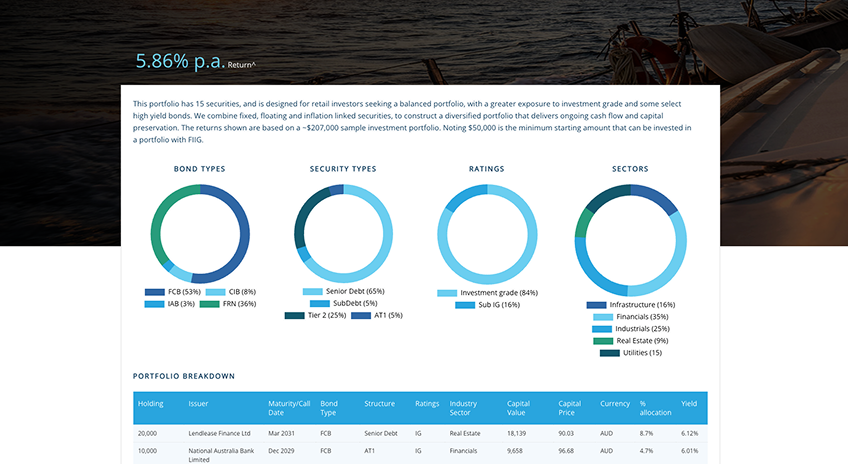
Every FIIG client portfolio is personalised. You can build your own individual portfolio from over 1,000 available bonds. But the best way to understand what fixed income investing looks like in practice is to see real examples — the types of bonds held, the income generated, and how the strategy varies by risk profile and investment size.
FIIG offers illustrative sample portfolios across three profiles:
- Conservative — Investment grade bonds only*. Predictable income, lower risk. Suited to investors who prioritise capital preservation above all.
- Balanced — A mix of investment grade and higher-yielding bonds. A higher return potential with a moderate increase in risk.
- High Yield — A greater allocation to below investment grade bonds. For investors seeking the highest available income and comfortable with the associated risk profile.
*Investment grade bonds are issued by entities with stronger credit ratings, indicating a lower risk of default compared with below-investment-grade bonds.
Sample portfolios are available for both retail investors (minimum investment typically $10,000 per bond) and wholesale investors (higher minimums, access to a broader range of bonds).
What is a retail investor?
A retail investor is any individual investing personal funds who does not meet the criteria to be classified as wholesale. Retail investors are protected by additional regulatory requirements under Australian law.
What is a wholesale investor?
A wholesale investor is someone who meets at least one of the following criteria under the Corporations Act 2001: net assets of at least $2.5 million, gross income of at least $250,000 per year for the last two financial years, or is investing a minimum of $500,000 in a single transaction. Wholesale investors have access to a broader range of investment products with fewer regulatory restrictions.

Download sample portfolios
Download a sample portfolio (button above) to see the types of bonds, coupon rates, maturities, and projected income that a FIIG portfolio at your investment level could generate.
Well done — you've completed the learning path
You now have a clear picture of why direct bond ownership is the smarter way to invest in bonds.
Why direct ownership beats ETFs
How FIIG gives you an edge
How your investments are protected
Open a FIIG account to:
Start building your bond portfolio online today
Access FIIG-exclusive bonds — including DCM-arranged deals not available on the open market
Start earning — receive monthly reporting, research, and ongoing strategy support
By opening a FIIG account you'll be able to view 1,000+ available bonds, explore model portfolios, and see the annual income your portfolio could generate — all online.
Meet Your Fixed Income Experts
Not ready to open an account? Book a no-obligation call with a specialist first.

Daniel Swane
Business Development Associate, Fixed Income
M: 0456 587 909 E: Daniel.Swane@fiig.com.au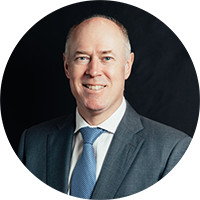


You're ready to build your own bond portfolio
You now understand how direct bonds compare with broad bond exposure, how to use different types of bonds to shape income and risk, and how FIIG’s platform and expertise support more sophisticated portfolio decisions.
Well done. I hope you’ve found it helpful!
Jessica Rusit
FIIG – Director – Investment Strategy
The best step forward is now to open your account and start reviewing the list of available bonds. I look forward to speaking to you on my quarterly investor webinars about global markets and opportunities we are seeing in bond markets.