
Learning Path : I'm familiar with fixed income
Good choice! Let's take your knowledge further
Estimated time: 10-12 minutes to complete
By the end of this path, you’ll have everything you need to confidently evaluate bonds as part of your portfolio — and to open a FIIG account and start building a portfolio of bonds. At any time during the process, you can choose to speak with a FIIG Fixed Income Expert by clicking the “Talk to an Expert” button above, and they’ll call you back to discuss investing in bonds.
You’re already aware that bonds can provide a regular income along with capital preservation, that’s great. But are you aware they also offer diversification across asset classes? Read on to find out how bonds can provide an insurance policy during market downturns.
Learning goals
- How to use bonds to diversify your portfolio
- How to select the right bond type for each market condition
- How to maximise returns through bond trading
- How to access Australia's $2 trillion bond market through FIIG
Meet your expert guides
Throughout this journey, you’ll receive insights from experienced specialists on FIIG’s Investment Strategy and Research team — professionals who help Australians achieve their retirement income goals every day.

Jessica Rusit
Director – Investment Strategy
12+ years of experience in financial markets
Philip Brown
Head of Research
20+ years of experience in researchHow do bonds offer diversification?
Diversification is key when investing, both inside each asset class and across asset classes. If your portfolio is dominated by equities, or properties, you are exposed to unexpected results in that particular asset class.
Did you know?
During the 2008 Global Financial Crisis, Australian government bond prices rose significantly while equity markets fell by more than 50%. Bonds did exactly what they were designed to do.
Bonds provide excellent diversification from market volatility and weakness that can negatively impact other asset classes. Equities and bonds tend to move in opposite directions. In major recessions, share prices will likely fall considerably and property prices will likely also somewhat soften.
However, a carefully constructed bond portfolio can deliver reliable monthly income through market cycles. When riskier assets are falling in price during periods of market volatility, bonds will typically hold their price while continuing to pay regular income and if the cash rate, as set by the RBA, falls fixed price bonds can actually increase in price. A weaker economic environment which will impact asset prices, tends to lower the cash rate which will lower bonds and increase fixed rate bond prices.
Remembering, the coupon payments on a bond are a legal obligation of the issuer, however dividends are not mandatory and profits can be retained during times of economic downturn rather than paid to shareholders. This makes bonds preferable during times of stress as well as offering diversification across other asset classes, there are even significant diversification possibilities inside the bond asset class.
I always tell clients: don't just think of bonds as one asset class. Fixed rate, floating rate, and inflation-linked bonds each behave differently — so a well-built bond portfolio is diversified within itself, not just against shares and property.
Jessica Rusit
FIIG – Director – Investment StrategyYou now know bonds diversify across asset classes. But did you know each type of bond is designed to protect you against a specific economic threat?
Bonds protect against economic conditions
There are three main different types of bonds: fixed rate, floating rate note and inflation linked bonds. Each of these have a different return profile and are designed for slightly different market situations and objectives. Through this they provide diversification within the asset class as well as protecting against economic conditions.
Fixed rate bonds
You’re familiar with fixed rate bonds; they are standard bonds with a fixed coupon paid until maturity. But did you know they offer a form of hedging during market downturns?
When the Reserve Bank of Australia (RBA) lowers interest rates in response to a recession, this can cause the value of fixed rate bonds to rise. This is even better than diversification, it’s direct protection of your capital. If well designed, your fixed rate bond portfolio will likely have its best returns exactly when your share portfolio is having its worst returns. This is the diversification and benefit of holding a bond portfolio alongside equities and property.
Floating rate notes
You’re aware a floating rate note pays a margin over a floating benchmark, but did you know the benefit of this?
When the outlook is for future interest rate rises, the floating benchmark will typically increase to reflect this. As such, the coupon rates on floating rate notes will increase also and provide a higher level of income. Floating rate notes allow investors to benefit from a rise in interest rates.
As the coupon rates on these bonds are reset frequently, and the underlying floating benchmark is linked to the interest rate outlook, these are the most capital stable bonds on offer and tend to have higher yields than simple deposits.
Inflation linked bonds
Inflation can be a major risk for wealth erosion and depletion of savings in real terms, but bonds can directly protect against this.
Inflation linked bonds protect investors against inflationary pressures while maintaining a steadily growing income flow. These types of bonds offer inflation protection by keeping income paid to investors in step with the quarterly CPI releases. The real yield ensures that the bondholder is covered against any unexpected spike in inflation, as measured by the CPI release.
By including an exposure to all three types of bonds you can materially lessen the risks in your overall investment portfolio and better protect against economic conditions.
A diversified bond portfolio isn't just one type of bond — it's a combination of all three, weighted to reflect your view on where interest rates and inflation are heading. That's where the real protection comes from.
Philip Brown
FIIG - Head of ResearchSo bonds protect your capital. But can they also actively grow your returns beyond what the stated yield suggests?
Bonds can provide attractive returns
You're aware of the types of yields that bonds can offer, but did you know that well-managed bond portfolios tend to outperform their yields over time?
Returns beyond yield
Experienced bond investors use market timing, new issue premiums, and pull-to-par strategies to outperform the stated yield. With the help of your dedicated Relationship manager, these opportunities can be identified in your portfolio and put in place.
This is because bonds have a term structure, new issue premiums, and other market nuances that allow strategies to be implemented to maximise returns and further improve a bond's yield. With the help of FIIG Research — and at any time by speaking with a FIIG Relationship Manager — you can identify ways in which your bond portfolio can achieve better returns.
While bonds offer attractive yields on a hold-to-maturity basis, investors can take advantage of these market and bond nuances to achieve an even higher return than the simple yield would suggest. Implementing specific strategies as mentioned above, can result in the capital price of the bond increasing, allowing a noteholder to sell and lock-in capital gains, which further enhance the returns. The best returns from bond portfolios comes from both knowing which bonds to buy and when, but also which bonds to sell, and when.
Although a bond portfolio can be set-and-forget, there’s the added benefit of trading positions to improve returns. FIIG clients can place a trade via their Relationship Manager, or directly via the client portal, MyFIIG. Keep reading to find out how buying and selling bonds can achieve this.
The yield on a bond is the floor, not the ceiling. Knowing when to buy, and just as importantly when to sell, is where the real value gets unlocked — and it's something FIIG's research team focuses on every day.
Jessica Rusit
FIIG – Director – Investment StrategyIf bonds can be bought and sold before maturity, how do investors actually profit from that — and what drives bond prices up and down?
Trading bonds to maximise returns
You're familiar that bonds don’t need to be held until maturity, and that they can be sold prior, but were you across the benefits of this?
At every step along the way, a dedicated Relationship Manager can assist and suggest ways to improve returns for a portfolio. One of the key benefits of bonds, is the ability to buy and sell them prior the maturity date- which not all investment options offer.
The key benefits include:
- Good liquidity: There is a large active bond market both in Australia and globally, which creates a pool of buyers and sellers – and as such good liquidity. This means that if you need to sell your holding, you can do so relatively easily at any time.
- Ability to make capital gains: With a known maturity price, and market dynamics impacting the price, this allows for a bond holder to sell ahead of the maturity date at a time when the capital price is above par to achieve a better return.
- Switches to improve relative value: Furthermore, as bonds mature and redeem, new bonds are being issued into the market, which can offer better relative value compared to existing bonds in a portfolio. The liquid bond market allows you to sell a holding and switch into a newer bond, that may provide a higher return.
Your bonds have the potential to move up and down in price each day, but they will mostly stay near to their original purchase price. When a bond is nearing its maturity date, their prices move back towards their original capital price, which is a concept known as "pull-to-par" (par being $100). The yields can rise for many reasons, but two key drivers are outright interest rate risk, when the level of interest rates moves for all bonds together at once. There is also more specific risk related to the credit profile of the particular company or government that issued your bond in the first place.
The liquid bond market gives you options that many investors don't realise they have. Bonds trade in an active market, whereas term deposits are typically held to maturity, and this is one of the benefits of direct bond ownership over a term deposit.
Philip Brown
FIIG - Head of ResearchYou now know how to trade bonds for better returns — but just how big and liquid is the market you're trading in?
The Australian bond market
The Australian dollar bond market is approximately $2 trillion in bonds outstanding and is larger than the ASX. The size of the markets provides better liquidity and more choice for investors. Bonds are traded "over-the-counter" (referred to as the OTC market), which is a private agreement between seller and buyer (which is similar to buying or selling a house).
A market most investors never see
Despite being larger than the ASX, the $2 trillion Australian bond market has historically been out of reach for retail investors. FIIG changes that.
FIIG is Australia’s leading fixed income specialist and operates as a bond broker, matching sellers with buyers, and vice versa, in the bond market. The Australian bond market continues to mature and evolve, with off-shore issuers increasingly launching new transactions locally, attracted by the size of the investor base, stable markets and funding diversification. FIIG also created and established its own online trading portal for clients, giving clients access to place orders on their portfolio to be executed in real-time. This is another example of the continual innovation FIIG brings to fixed income.
FIIG has been in this market since 1998. So who are we — and why does that track record matter to you as an investor?
How do you buy bonds?
Bonds can easily be bought, held and even sold once a FIIG account has been established. This can be done online via a few simple clicks, or you can ring to speak with a FIIG Fixed Income expert or arrange a face-to-face meeting at any time in one of our offices in Sydney, Melbourne, Brisbane or Perth.
FIIG is more than just a broker
Every FIIG client gets a dedicated Relationship Manager, monthly reporting, and direct access to FIIG's Research and Investment Strategy team — support that goes well beyond simply executing a trade.
As part of becoming a FIIG client, a bond investor has a dedicated Relationship Manager to help at any time, along with access to monthly portfolio reporting, and to publications from the Research and Investment Strategy teams. These include the quarterly macro-outlook, which provides insights into the market outlook, along with bond specific credit updates, strategy articles, our weekly newsletter for clients called “Smart Income”, as well as seminars and webinars. Client assets are held in segregated safe custody by J.P. Morgan, a leading global custodian, providing an additional layer of security and protection of client assets.
FIIG clients also have the ability to trade online via the client portal, MyFIIG, where clients have the ability to select from over 1,000 bonds. The portal allows clients to compare the returns, coupons, and credit rating of bonds to help with
Ready to take control of your bond portfolio?
Open a FIIG account and start investing in direct bonds today.
Open your FIIG accountFIIG is Australia's leading fixed income specialist — trusted by 6,000+ investors since 1998.
Prefer to speak with an expert first? Book a free consultation to learn how fixed income can work for your situation.
You now know how to open and manage your account — so what does FIIG's own track record and credibility actually look like?
Who is FIIG Securities?
FIIG is one of the leading and most established pure fixed income advisory houses in Australia, established in 1998 and has been at the forefront of providing fixed income access to investors. FIIG has offices in four capital cities, including; Sydney, Melbourne, Brisbane and Perth, providing over 6,000 clients with access to a diverse range of bonds, including government bonds, Corporate bonds, Residential Mortgage Back Securities (RMBS), high yield, non-AUD denominated bonds and securitised notes. FIIG has grown to over $4.5bn in Funds Under Administration (FUA) and were acquired by AUSIEX (Australian Investment Exchange Limited) in June 2025.
FIIG has originated over 100 transactions through its Debt Capital Markets (DCM) division, enhancing returns for fixed income investors in the Australian bond market. These in-house originated transactions are exclusively available to FIIG clients and offer unique high yielding exposures to portfolios.
AUSIEX is one of Australia’s leading providers of trading execution, clearing and settlement, and portfolio administration services for financial institutions, advisers, wealth platforms and intermediaries. AUSIEX has been owned by global Japanese technology and financial services group, Nomura Research Institute (NRI), since 2021. NRI has a market capitalisation of $28.8bn as of July 2026. The acquisition has further enhanced FIIG’s ability to offer the best level of systems and service to its clients.
Backed by AUSIEX and Nomura Research Institute
AUSIEX's acquisition of FIIG connects clients to one of Australia's leading trading, clearing and settlement providers — itself backed by NRI, a global financial technology group with a market capitalisation of $28.8bn.
FIIG over the past two-years has upgraded its systems to improve security, while it also annually undertakes an independent assurance report on internal controls relating to its custody Service. This audit (GS007 type 2) is an international standard to which Global Custodians adhere.
Now that you know who's behind FIIG's scale and security — what does that mean for how you can actually put your money to work?
Portfolio examples
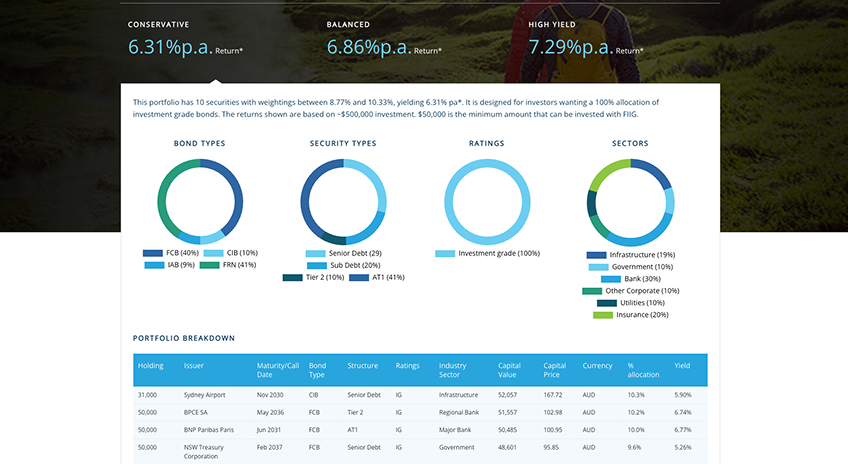
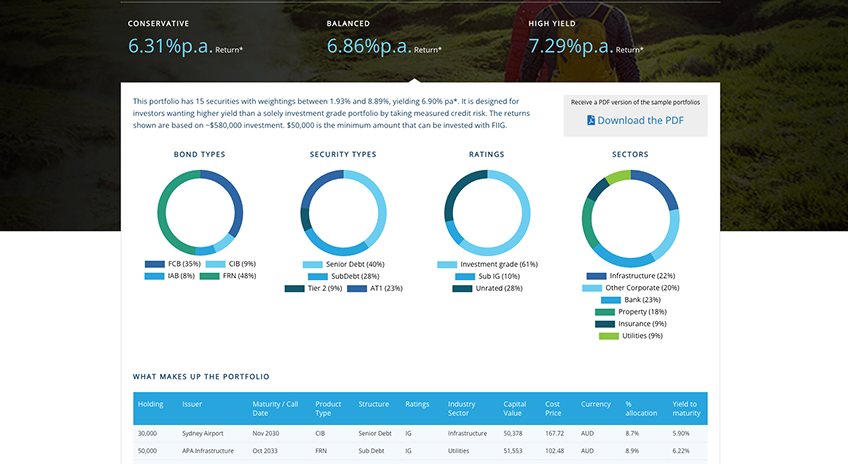
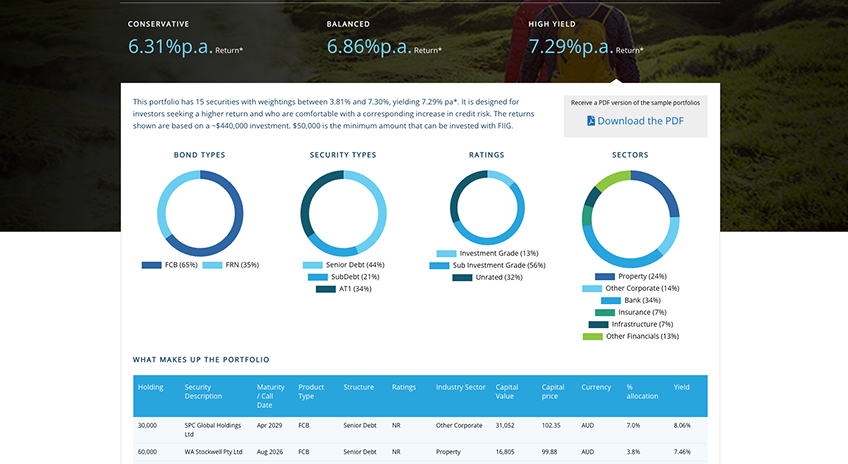
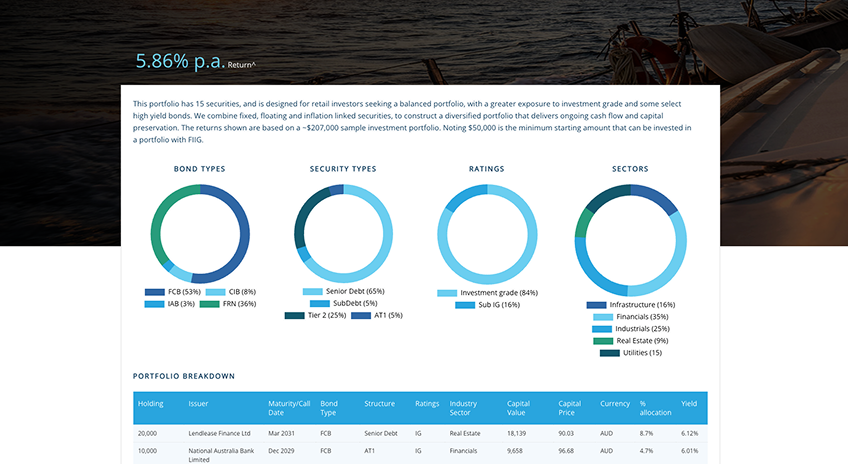
Every FIIG client portfolio is personalised. You can build your own individual portfolio from over 1,000 available bonds. But the best way to understand what fixed income investing looks like in practice is to see real examples — the types of bonds held, the income generated, and how the strategy varies by risk profile and investment size.
FIIG offers illustrative sample portfolios across three profiles:
- Conservative — Investment grade bonds only*. Predictable income, lower risk. Suited to investors who prioritise capital preservation above all.
- Balanced — A mix of investment grade and higher-yielding bonds. A higher return potential with a moderate increase in risk.
- High Yield — A greater allocation to below investment grade bonds. For investors seeking the highest available income and comfortable with the associated risk profile.
*Investment grade bonds are issued by entities with stronger credit ratings, indicating a lower risk of default compared with below-investment-grade bonds.
Sample portfolios are available for both retail investors (minimum investment typically $10,000 per bond) and wholesale investors (higher minimums, access to a broader range of bonds).
What is a retail investor?
A retail investor is any individual investing personal funds who does not meet the criteria to be classified as wholesale. Retail investors are protected by additional regulatory requirements under Australian law.
What is a wholesale investor?
A wholesale investor is someone who meets at least one of the following criteria under the Corporations Act 2001: net assets of at least $2.5 million, gross income of at least $250,000 per year for the last two financial years, or is investing a minimum of $500,000 in a single transaction. Wholesale investors have access to a broader range of investment products with fewer regulatory restrictions.

Download sample portfolios
Download a sample portfolio (button above) to see the types of bonds, coupon rates, maturities, and projected income that a FIIG portfolio at your investment level could generate.
Now let's look at the next steps in building your own portfolio.
Well done — you've completed the learning path
Here's what you now know and what’s waiting on the other side.
How bonds provide diversification across and within asset classes
How different bond types protect against inflation, rate rises, and market downturns
How active management can improve returns beyond the stated yield
Open a FIIG account to know
What bonds are available — and what income do they pay
What does a real diversified portfolio look like?
How do I open an account and place my first order?
By opening a FIIG account you'll be able to view 1,000+ available bonds, explore model portfolios, and see the annual income your portfolio could generate — all online.
Meet Your Fixed Income Experts
Not ready to open an account? Book a no-obligation call with a specialist first.

Daniel Swane
Business Development Associate, Fixed Income
M: 0456 587 909 E: Daniel.Swane@fiig.com.au


You've taken your knowledge further
You now understand how bonds can diversify a portfolio, how different bond types respond to market conditions, and how direct bond ownership can support your investment approach.
Well done. I hope you’ve found it helpful!
Jessica Rusit
FIIG – Director – Investment Strategy
The best step forward is now to open your account and start reviewing the list of available bonds. I look forward to speaking to you on my quarterly investor webinars about global markets and opportunities we are seeing in bond markets.