
Learning Path : I'm new to fixed income
Good choice! We’ll help you build the foundation first
Estimated time: 10-12 minutes to complete
We'll help you understand fixed income, open an account, select your bonds and place an order to buy, all online. At any time during the process, you can choose to speak with a FIIG Fixed Income Expert by clicking the “Talk to an Expert” button above, and they’ll call you back to discuss investing in bonds.
Bonds are one of the simplest ways to earn regular, predictable income from your investments — and they're used by everyone from first-time investors to retirees. This learning path will walk you through what bonds are, how they work, and how to build your first bond portfolio with FIIG.
Learning goals
- What fixed income is, and why investors use it
- How bonds generate income and can help protect your capital
- How bonds compare to shares and property in your portfolio
- How to open an account and start investing through FIIG
Meet your expert guides
Throughout this journey, you’ll receive insights from experienced specialists on FIIG’s Investment Strategy and Research team — professionals who help Australians achieve their retirement income goals every day.

Jessica Rusit
Director – Investment Strategy
12+ years of experience in financial markets
Philip Brown
Head of Research
20+ years of experience in researchWhat is fixed income and why investors choose it
If you’ve been investing in property or shares, the phrase "fixed income" might feel unfamiliar, and that’s OK. Most Australian investors encounter it for the first time when they're approaching retirement, managing an SMSF, or looking for somewhere stable to put the capital received from a property or a business sale.
Fixed income is simply what it sounds like: investments that pay you a fixed, regular income, and bonds are the most common form of fixed income.
What is a bond
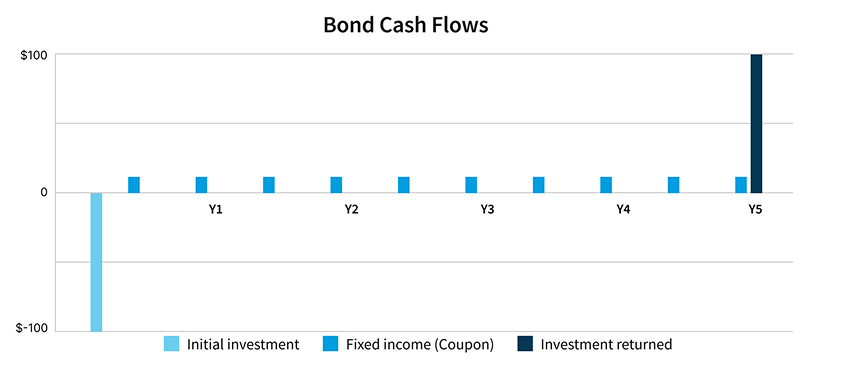
You lend money to a borrower — typically a well-known company or a government. In return, they pay you regular interest (called a coupon) on a set schedule, and they return your original investment (called the face value or principal) in full at the end of an agreed term (called the maturity date).
With bonds, you know what you're getting, when you're getting it, and that you should get your money back — provided the issuer remains solvent. That makes your income predictable and secure, and hence the name "Fixed Income."
One thing many investors don't realise
Bonds don't have to be held until maturity — they can be bought and sold at any time. So while you get the certainty of fixed income and a known end date, you're never locked in if your circumstances change.
Who issues bonds
The companies that issue bonds include names you already know and trust: Commonwealth Bank, Telstra, Qantas, Sydney Airport — alongside State and Federal Government bonds.
Now that you know what a bond is, the next natural question is: what kind of returns can you actually expect?
What returns can fixed income realistically generate?
The returns on bonds vary depending on several factors. One is the tenor of the bond — that is, how long until the bond matures and you get your principal back. Longer dated bonds typically pay higher returns compared to bonds with a shorter term. Another factor is the credit quality of the issuer, usually measured by a company's credit rating, which reflects the issuer's ability to meet coupon and principal repayments. Higher quality issuers will generally have a lower coupon than higher risk issuers. The interest rate backdrop at the time of investment also plays a role, among other factors. The yield to maturity is the implied return of the bond and incorporates both income and capital returns. As such, it is the best measure to use when comparing bond returns.
As a general guide, a Conservative fixed income portfolio contains only investment grade bonds — bonds issued by companies or governments considered financially stable and likely to meet their repayment obligations — and would achieve a return in the 5% to 6% range. A Balanced portfolio, which has a mix of investment grade and sub-investment grade bonds, would achieve a return in the 6% to 8% range. The highest return can be achieved with a High Yield portfolio, which has a larger allocation to sub-investment grade bonds and a smaller allocation to investment grade bonds, and can provide a return in the range of 8% to 12%.
| Portfolio type | Bond mix | Expected return range |
|---|---|---|
| Conservative | Investment grade bonds only | 5%–6% |
| Balanced | Investment grade + some higher-yield | 6%–8% |
| High Yield | Higher allocation to sub-investment grade | 8%–12% |
This is where dealing with the leading Australian fixed income firm is important. Our independent research and model portfolios will help you select the best risk adjusted bonds for your portfolio.
Jessica Rusit
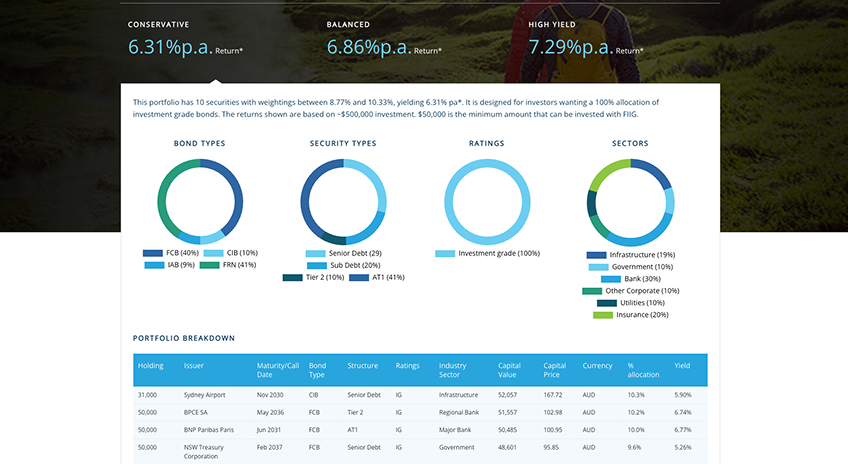
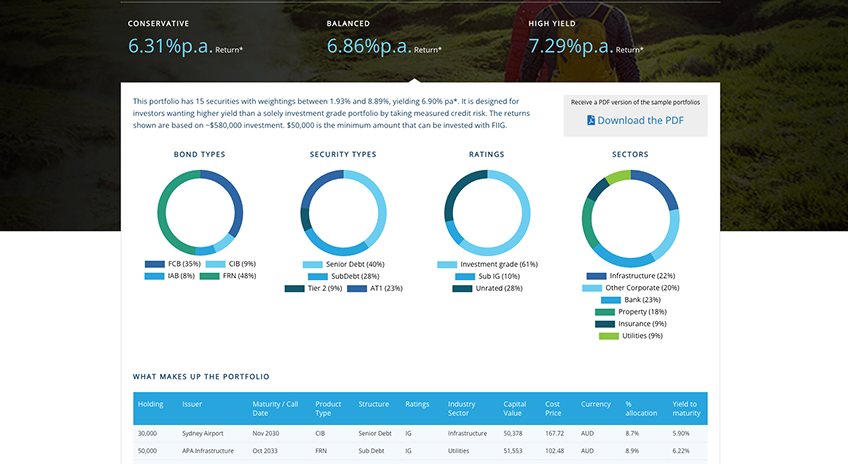
FIIG – Director – Investment StrategyOur Retail and Wholesale Sample portfolios show what income can be achieved from a bond portfolio. These are illustrative to give some better insight into the types of returns and cashflows that bonds can provide.
How much of my portfolio should be allocated to bonds?
The investors who typically discover fixed income share a few things in common. They're not beginners. They've built something — a property portfolio, a share portfolio, a business, or a superannuation balance — and now they're asking a more sophisticated question: what do I do with what I've built?
Fixed income tends to be most relevant to investors who are:
- Approaching or in retirement — needing a reliable income stream to replace their salary, without depending on market performance
- Managing an SMSF — where predictable returns and regular distributions help meet fund obligations and investment strategy requirements
- Holding proceeds from an asset sale — a property sale, a business exit, or a significant inheritance that needs somewhere stable while longer-term decisions are made
- Seeking to reduce volatility — investors who want part of their portfolio to be predictable, regardless of what markets are doing
There's a well-known rule of thumb, an investor should hold a bond allocation roughly equal to their age. A 55-year-old, on this basis, would consider 55% of their portfolio in bonds. The logic is simple: the older you get, the more important income predictability and capital preservation become relative to growth.
There's no one-size-fits-all number
At FIIG, we work with investors across a wide range of allocations. The right proportion for you depends on your goals, your other assets, and your income needs in retirement.
Once you've decided on the allocation you want to make to fixed income, you will be able to review over 1,000 available bonds, FIIG's research and model portfolios to design a portfolio right for your needs. You can do this all online, or at any time you can speak with one of our Fixed Income Experts to help you through the process.
How fixed income protects your capital
A bond’s coupon and principal repayments are a legal obligation of the issuer. A missed coupon payment or failure to repay principal is considered to be an event of default of that company or government. This is quite different to shares, where the dividend is a choice of the company board and can be partially paid or not paid at all depending on circumstances. Bond coupons and principal payments must be met.
Bond investors are also protected by covenants which are agreements from the issuing entity to behave in certain ways. This can be ensuring certain financial ratios are maintained or that some types of future activity are not allowed.
Covenants add another layer of protection
Covenants are agreements from the issuer to behave in certain ways — such as maintaining specific financial ratios or avoiding certain future activities. They give bondholders added assurance beyond the coupon and principal repayment obligations.
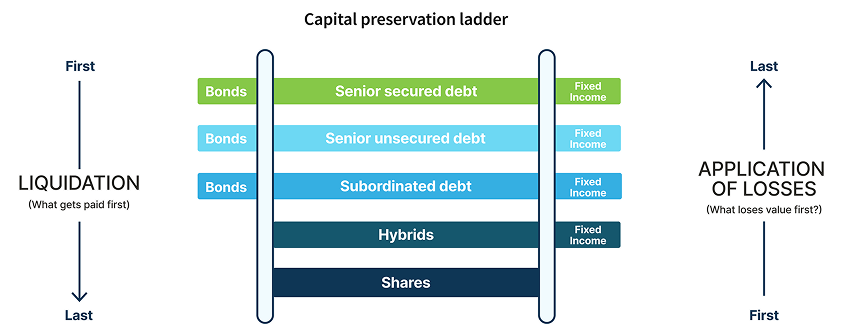
A bond sits high in a company’s capital structure, which determines the order of repayments of the liabilities of an issuer should they go into default. Bonds are much higher than shares in the structure which means shareholders would lose the value of their investment much earlier than bondholders, while also being paid last in the event of default. These features help to preserve a bond investor’s capital.
You now understand how bonds protect your capital. But how does that protection actually compare to the shares or property you may already hold?
The Australian bond market
The Australian dollar bond market is approximately $2 trillion in bonds outstanding and is larger than the ASX. The size of the markets provides better liquidity and more choice for investors.
The size of this market is something most investors never see — it's larger than the ASX, yet almost entirely invisible to everyday investors until they come to FIIG.
Jessica Rusit
FIIG – Director – Investment StrategyOTC - Over The Counter Market
Bonds are traded “over-the-counter” (referred to as the OTC market), which is a private agreement between seller and buyer (which is similar to buying or selling a house). FIIG is Australia’s leading fixed income specialist and operates as a bond broker, matching sellers with buyers, and vice versa, in the bond market. FIIG was established in 1998 and has over 6,000 clients and $4.5 billion in funds under management, along with access to over 1,000 bonds in AUD-denominated bonds as well as non-AUD denominated bonds.
Australia's leading fixed income specialist
FIIG operates as a bond broker, matching buyers and sellers in the bond market. Established in 1998, FIIG now serves over 6,000 clients with $4.5 billion in funds under management, and access to more than 1,000 AUD and non-AUD denominated bonds.
You now know how big and liquid this market is — so what does it actually take to open an account and start buying?
How do you buy bonds?
Bonds can easily be bought, held and even sold once a FIIG account has been established. This can be done online via a few simple clicks, or you can ring to speak with a FIIG Fixed Income expert or arrange a face-to-face meeting at any time in one of our offices in Sydney, Melbourne, Brisbane or Perth.
As part of becoming a FIIG client, a bond investor has a dedicated Relationship Manager to help at any time, along with access to monthly portfolio reporting, and to publications from the Research and Investment Strategy teams. These include the quarterly macro-outlook, which provides insights into the market outlook, along with bond specific credit updates, strategy articles, FIIG’s weekly newsletter for clients called “Smart Income”, as well as seminars and webinars. Client assets are held in segregated safe custody by J.P. Morgan, a leading global custodian, providing an additional layer of security and protection of client assets.
What clients appreciate most is the flexibility — you can build and manage your portfolio entirely online, but there's always a Relationship Manager just a call away when you want a second opinion.
Jessica Rusit
FIIG – Director – Investment StrategyFIIG clients also have the ability to trade online via the client portal, MyFIIG, where there are over 1,000 bonds to choose from. The portal allows FIIG clients to compare returns, coupons, and credit rating, among other key features to make a more-informed selection. Through MyFIIG, clients have the ability to not only place orders, but also monitor their orders in real-time.
Ready to take control of your bond portfolio?
Open a FIIG account and start investing in direct bonds today.
Open your FIIG accountFIIG is Australia's leading fixed income specialist — trusted by 6,000+ investors since 1998.
Prefer to speak with an expert first? Book a free consultation to learn how fixed income can work for your situation.
You now know how to open and manage your account — so what does FIIG's own track record and credibility actually look like?
Who is FIIG Securities?
FIIG is one of the leading and most established pure fixed income advisory houses in Australia, established in 1998 and has been at the forefront of providing fixed income access to investors. FIIG has offices in four capital cities, including; Sydney, Melbourne, Brisbane and Perth, providing over 6,000 clients with access to a diverse range of bonds, including government bonds, Corporate bonds, Residential Mortgage Back Securities (RMBS), high yield, non-AUD denominated bonds and securitised notes. FIIG has grown to over $4.5bn in Funds Under Administration (FUA) and were acquired by AUSIEX (Australian Investment Exchange Limited) in June 2025.
FIIG has originated over 100 transactions through its Debt Capital Markets (DCM) division, enhancing returns for fixed income investors in the Australian bond market. These in-house originated transactions are exclusively available to FIIG clients and offer unique high yielding exposures to portfolios.
AUSIEX is one of Australia’s leading providers of trading execution, clearing and settlement, and portfolio administration services for financial institutions, advisers, wealth platforms and intermediaries. AUSIEX has been owned by global Japanese technology and financial services group, Nomura Research Institute (NRI), since 2021. NRI has a market capitalisation of $28.8bn as of July 2026. The acquisition has further enhanced FIIG’s ability to offer the best level of systems and service to its clients.
Backed by AUSIEX and Nomura Research Institute
AUSIEX's acquisition of FIIG connects clients to one of Australia's leading trading, clearing and settlement providers — itself backed by NRI, a global financial technology group with a market capitalisation of $28.8bn.
FIIG over the past two-years has upgraded its systems to improve security, while it also annually undertakes an independent assurance report on internal controls relating to its custody Service. This audit (GS007 type 2) is an international standard to which Global Custodians adhere.
Now that you know who's behind FIIG's scale and security — what does that mean for how you can actually put your money to work?
Portfolio examples
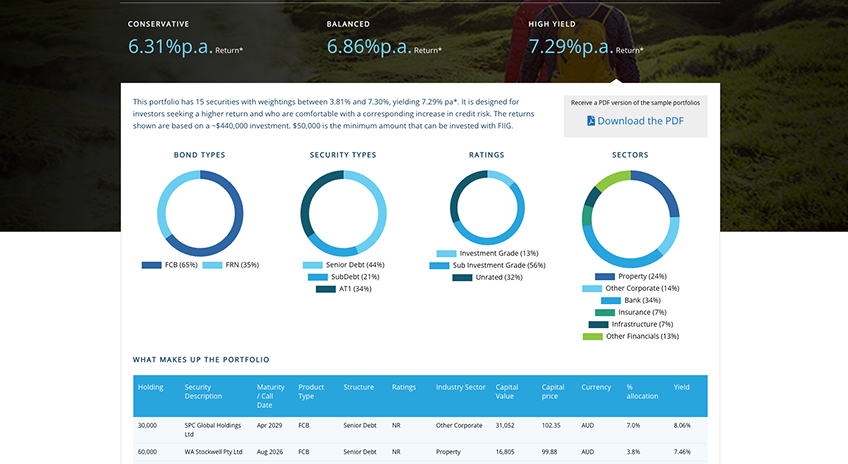
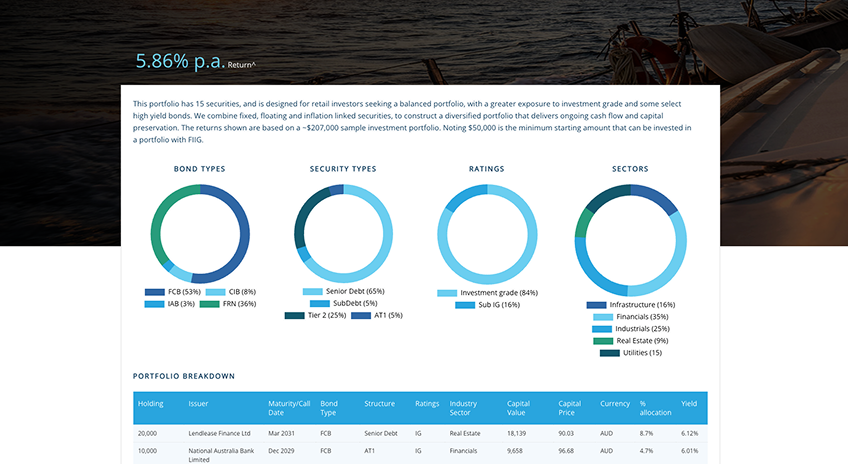
Every FIIG client portfolio is personalised. You can build your own individual portfolio from over 1,000 available bonds. But the best way to understand what fixed income investing looks like in practice is to see real examples — the types of bonds held, the income generated, and how the strategy varies by risk profile and investment size.
FIIG offers illustrative sample portfolios across three profiles:
- Conservative — Investment grade bonds only*. Predictable income, lower risk. Suited to investors who prioritise capital preservation above all.
- Balanced — A mix of investment grade and higher-yielding bonds. A higher return potential with a moderate increase in risk.
- High Yield — A greater allocation to below investment grade bonds. For investors seeking the highest available income and comfortable with the associated risk profile.
*Investment grade bonds are issued by entities with stronger credit ratings, indicating a lower risk of default compared with below-investment-grade bonds.
Sample portfolios are available for both retail investors (minimum investment typically $10,000 per bond) and wholesale investors (higher minimums, access to a broader range of bonds).
What is a retail investor?
A retail investor is any individual investing personal funds who does not meet the criteria to be classified as wholesale. Retail investors are protected by additional regulatory requirements under Australian law.
What is a wholesale investor?
A wholesale investor is someone who meets at least one of the following criteria under the Corporations Act 2001: net assets of at least $2.5 million, gross income of at least $250,000 per year for the last two financial years, or is investing a minimum of $500,000 in a single transaction. Wholesale investors have access to a broader range of investment products with fewer regulatory restrictions.

Download sample portfolios
Download a sample portfolio (button above) to see the types of bonds, coupon rates, maturities, and projected income that a FIIG portfolio at your investment level could generate.
Well done — you've completed the learning path
Here's what you now know and what’s waiting on the other side.
What fixed income is and why investors use it
The income a bond portfolio can realistically generate
What a diversified portfolio actually looks like
Open a FIIG account to know
What are the range of companies I can invest in?
What income do they pay?
Explore 1000+ bonds and build your portfolio online.
By opening a FIIG account you will be able to view the list of available bonds, select the bonds you would like to buy and see the annual income your bond portfolio will generate. And at anytime you would like to speak with a FIIG Fixed Income Expert your Relationship Manager will be available to assist.
Meet Your Fixed Income Experts
Not ready to open an account? Book a no-obligation call with a specialist first.

Daniel Swane
Business Development Associate, Fixed Income
M: 0456 587 909 E: Daniel.Swane@fiig.com.au


You've covered the foundation
You now understand what bonds are, how they generate income, how they protect capital, and what a bond portfolio looks like.
Well done. I hope you’ve found it helpful!
Jessica Rusit
FIIG – Director – Investment StrategyThe best step forward is now to open your account and start reviewing the list of available bonds. I look forward to speaking to you on my quarterly investor webinars about global markets and opportunities we are seeing in bond markets.